
Photo: designed by macrovector / Freepik
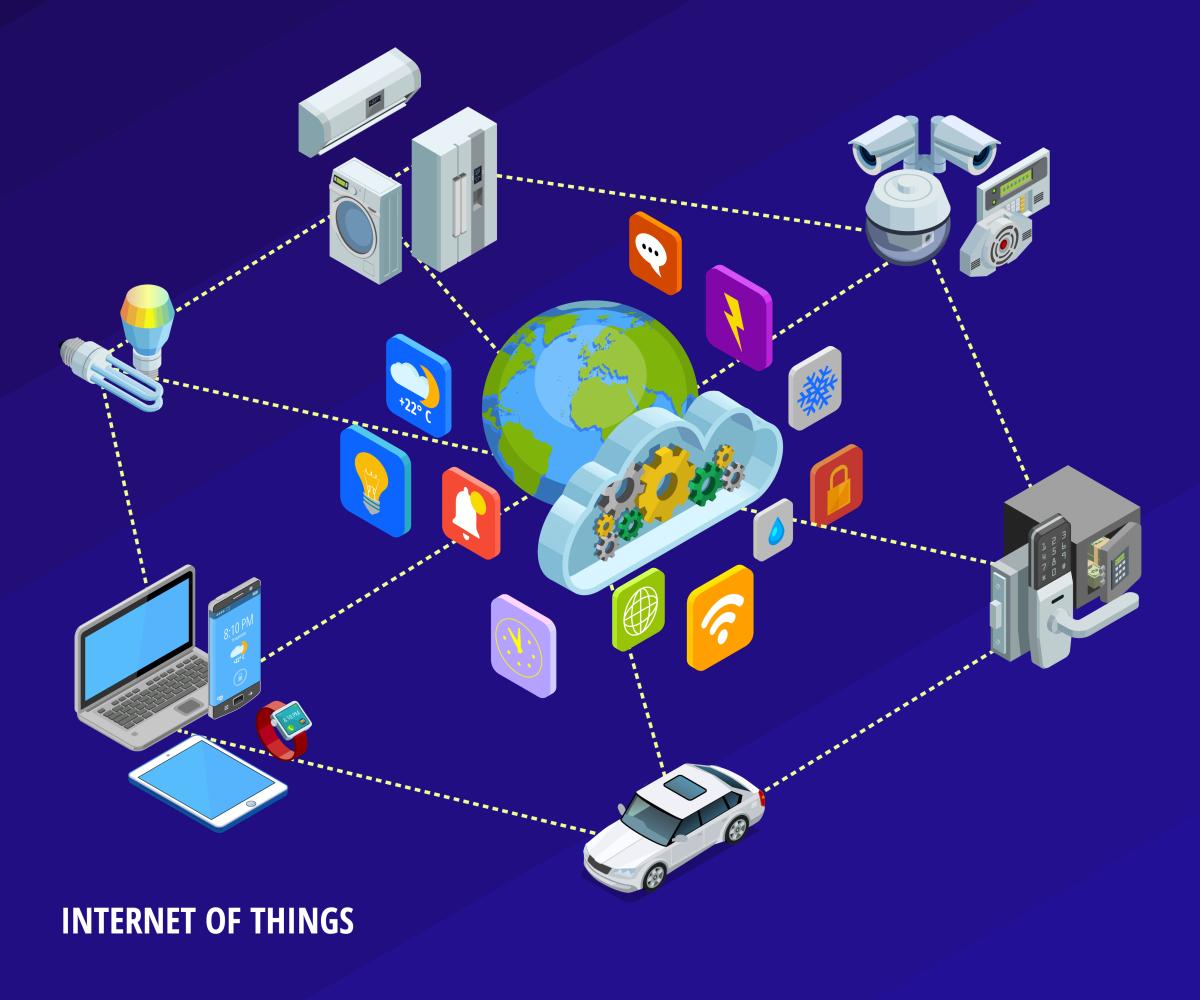
The Internet of Things refers to a network of physical objects - from everyday devices to industrial machines - that are equipped with sensors, software, and connectivity to collect and exchange data via the internet. Think of smart lighting, smart locks, medical monitoring equipment, or agricultural moisture sensors.
These devices are not only 'connected', but also capable of autonomously sending information and sometimes even making decisions based on data. The ultimate goal is always optimization; smarter lighting in your home to better monitor patients.
The Internet of Things in businesses
The business application of IoT is growing rapidly, especially in sectors where monitoring, automation, and data-driven decision-making are crucial. Some key applications:
- Smart offices: lighting, climate control, and access control are automated via IoT platforms.
- Industrial IoT (IIoT): factories use sensors to monitor machines and plan predictive maintenance.
- Logistics and supply chain: real-time tracking of goods and optimization of routes. How often do you check your Track & Trace when expecting a package?
- Healthcare: medical wearables provide data for remote patient monitoring.
- Retail: smart shelves, inventory management, and customer analysis in physical stores. The electronic price tags that have become the norm in recent years are a great example.
With real-time insights, these solutions provide assistance in various areas. From energy savings to decision-making, and from planning to error detection. And it does this in IT as well, but also adds extra components to the IT infrastructure. With the current increase in cyber threats, local storage is becoming increasingly popular. However, each additional device can also be an extra attack point. IoT thus leads to optimization but can also bring additional security risks.
What happens if the network connection fails?
And then there's the next point: What if your internet goes down? This often leads to frustration, but if your entire organization relies on devices connected to the internet... The answer depends on the type of device and the architecture:
- Standalone devices with local intelligence continue to perform their core functions. Think of a thermostat that continues to regulate internally based on preset values.
- Cloud-dependent devices may stop functioning or revert to an 'offline mode' with limited capabilities.
- Edge computing solutions handle this better: since data is processed locally, functionality remains largely intact without a direct cloud connection.
For organizations, it is crucial to consider offline behavior, fallback scenarios, and local processing capacity when selecting IoT solutions. Redundancy and failover mechanisms (such as dual-SIM or mesh networks) can further increase reliability.
IoT as a solution
The Internet of Things represents a structural change in how organizations deal with technology. From improved efficiency to entirely new services: IoT applications offer opportunities, but also require thoughtful management, robust infrastructure, and smart security. For IT professionals, knowledge of IoT is no longer a 'nice to have', but a necessity.