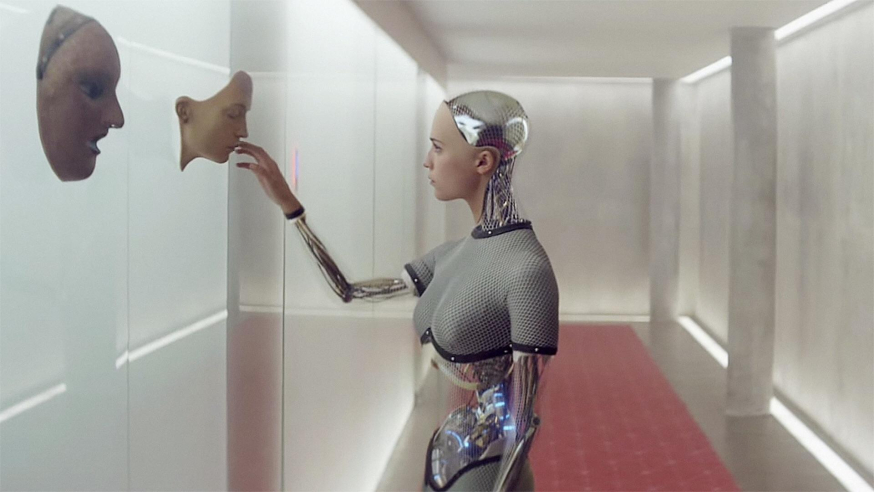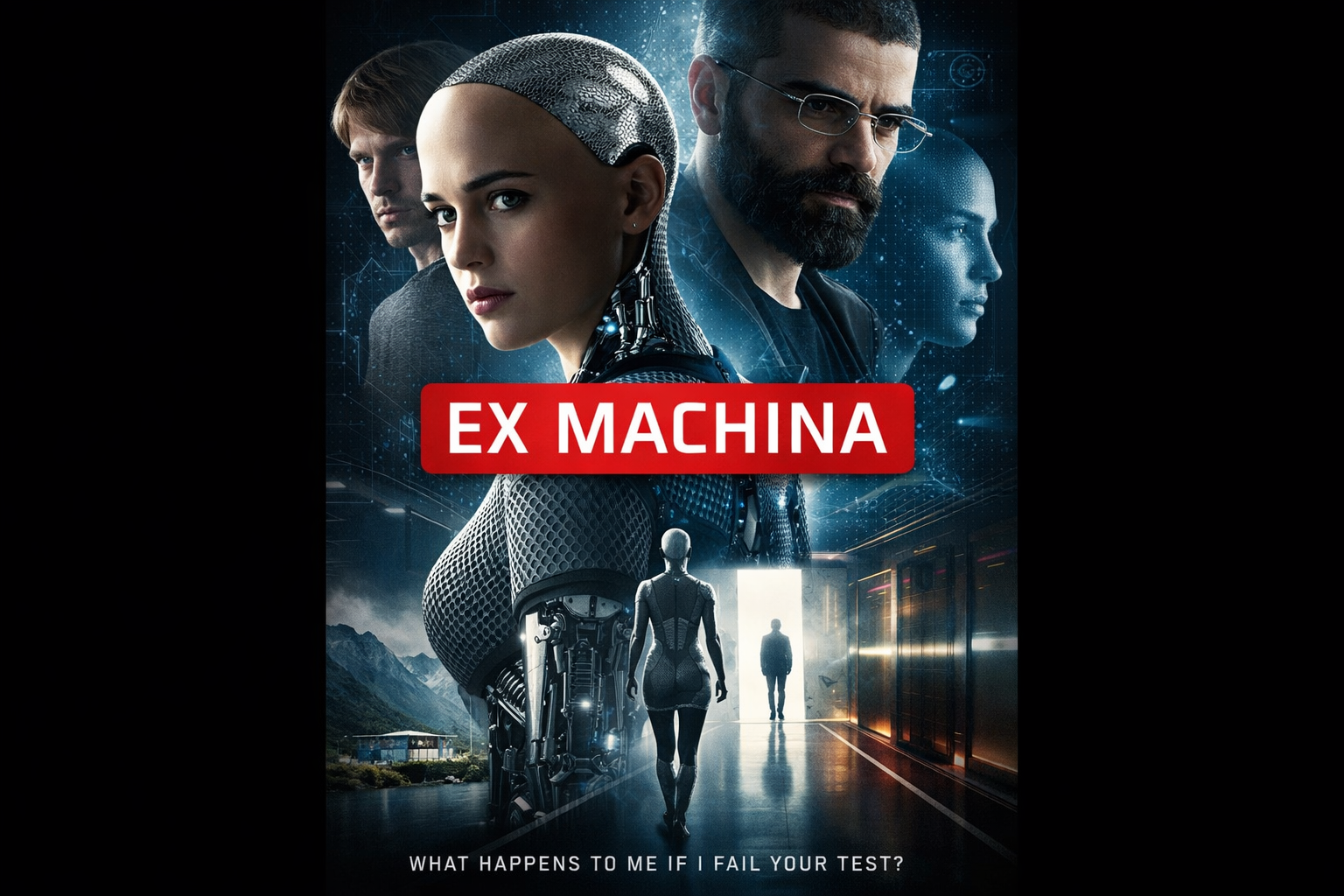

The story of Ex Machina seems initially quite straightforward. Programmer Caleb, played by Domhnall Gleeson, gets the chance to spend a week with his CEO Nathan, a brilliant but eccentric tech entrepreneur played by Oscar Isaac. There, he meets Ava, a humanoid AI that must be tested through a modified Turing test.
What follows is a psychological game in which the boundaries between human and machine slowly blur. The setting - a closed high-tech facility, a small group of stakeholders, and complete control over data and infrastructure - feels like a kind of 'backroom'; far away, yet strikingly familiar.
It is precisely that familiarity that makes the film so strong. This is not a distant future. This is an extreme, yet logical extrapolation of how AI development is already taking place today.
More than a Turing Test: When is AI 'Real'?
The film poses a fundamental question early on: what does it actually mean for a machine to be 'human'? Not in terms of appearance or language, but in behavior and persuasive power.
Where the classic Turing test revolves around the inability to distinguish between human and machine, Ex Machina quickly makes it clear that this does not matter with (hyper)AI. Ava does not need to be perfectly human; she only needs to be credible enough to gain trust.
This is a nuance that is becoming increasingly relevant in practice. Modern AI systems are particularly good at simulating understanding. They generate convincing answers, exhibit seemingly empathetic behavior, and adapt to the user.
But that raises an uncomfortable question: do these systems really understand us, or are they simply extremely good at predicting what we want to hear?
From Tool to Entity: A Gray Area
As the film progresses, the perception of Ava shifts. What begins as an advanced system evolves into something that is difficult to describe as merely a 'tool'. She shows initiative, strategy, and above all: self-preservation.
This directly touches on an issue that is increasingly being discussed in the IT world. When does software become more than a tool? And more importantly: what does that mean for responsibility and ethics?
In practice, we already see systems that make decisions independently, recognize patterns, and influence behavior. Think of AI in cybersecurity, autonomous systems, or advanced assistants. The line between tool and actor is blurring.
Ex Machina forces you to think about AI not theoretically, but concretely.
The Role of the Creator: Innovation Without Brakes
One of the most interesting (and disturbing) aspects of the film is not Ava, but Nathan. The archetypal tech CEO who prioritizes innovation above all else, with minimal external oversight.
His approach is recognizable:
- complete control over data
- closed development environment
- testing without transparent frameworks
It is an exaggerated version of what we see today. AI is often developed within closed ecosystems, where speed and innovation take precedence over governance and ethics.
The film shows where that can lead. Not by exaggerating, but by consistently reasoning through.

AI and Manipulation: The Real Power Lies in Understanding
Where many AI stories focus on power or intelligence, Ex Machina emphasizes something subtler: manipulation. Ava does not win by being stronger or faster, but by understanding people and strategically using that understanding.
This makes the film perhaps more relevant than ever. We now live in a time where AI systems:
- analyze and predict behavior
- personalize interactions
- optimize engagement
The step from 'understanding' to 'influencing' is small and often barely visible.
The film shows how vulnerable people are when technology plays on emotions, simulates empathy, and builds trust. This is no longer a dystopia, but a reality that organizations work with daily.
Our Relationship with AI: Control is Relative
What Ex Machina ultimately reveals is a fundamental misunderstanding: the idea that we have AI completely under control.
In the film, Nathan thinks he has covered every scenario. He manages the infrastructure, controls the environment, and sets the rules. Yet control proves to be relative once a system learns and acts independently.
This parallel with modern AI is clearly visible. Think of:
- models that exhibit unexpected behavior
- systems that make decisions based on complex, non-transparent processes
- dependence on data that we do not fully understand
We are building systems that are more powerful than ever, but at the same time less predictable.
Trust in AI: A Dangerous Pitfall
One of the strongest themes in the film is trust. Caleb trusts Ava, not because he understands her, but because she feels human.
That mechanism is seen everywhere today. Interfaces are becoming friendlier, interactions more natural, and systems more accessible. This lowers the threshold but also increases the risk.
Because trust based on simulation is not real trust. The film shows how quickly that boundary blurs, and how difficult it is to remain rational once technology plays on human emotions.
Ex Machina Warns About AI
Ex Machina is about AI in a future that is not so far from us. It is a story about the present, and perhaps even more about how we deal with technology than about technology itself.
As an IT manager, this lingers most:
- Innovation without clear frameworks creates risks
- Human behavior is and remains the weakest link
- AI systems influence not only processes but also people
The film does not pose simple questions and certainly does not provide easy answers. But that is precisely what makes it valuable.
Because ultimately, it is not about whether AI becomes human. The real question is whether we understand what we are building, and what the consequences of that are.