
The classic role of IT revolved around facilitation. Systems had to work, outages had to be resolved, and new tools were added when needed. That role has not disappeared, but it has fundamentally changed.
According to the Tech Trends 2026 report from Deloitte, IT is shifting to a continuous process of optimization. Systems are no longer fixed but are constantly being adjusted. Thus, IT is evolving into a management organization where technology, data, and processes come together.
This development is reinforced by the increase in complexity. Modern IT landscapes consist of cloud platforms, SaaS solutions, AI applications, and a growing number of integrations. Gartner speaks in this context of a hyperconnected environment where dependencies increase and oversight becomes more difficult.
As a result, organizations have access to more and more data, but often lack the context to interpret it. In Baaz Magazine, we show that the problem is not a lack of information, but a lack of insight.
From Insight to Control
This complexity calls for a different way of steering. Monitoring alone is no longer sufficient. Observability and AIOps make it possible to understand behavior within systems and to detect deviations early.
At the same time, the role of architecture and security is also shifting. Hybrid cloud, platform thinking, and zero trust are no longer isolated choices but form the basis for scalable IT.
The conclusion is clear: IT is becoming the backbone of the organization. Not just through technology, but by the extent to which that technology remains manageable.
Security as a Foundation for Scalable IT
As IT becomes more complex, the risk also grows. Cybersecurity is therefore no longer a separate discipline, but an integral part of how organizations function.
The challenge lies not only in stopping attacks but primarily in keeping security scalable. Growth means more users, more systems, and more data. Without a structural approach, security quickly becomes a hindrance to development.
From Disparate Security to Structural Model
The classic approach to cybersecurity, based on network boundaries and disparate tools, is no longer sufficient. In modern environments, security shifts to identity, context, and continuous verification.
Zero trust is a logical consequence of this. Access is determined not by location, but by the user and their behavior. This makes security more flexible and better scalable.
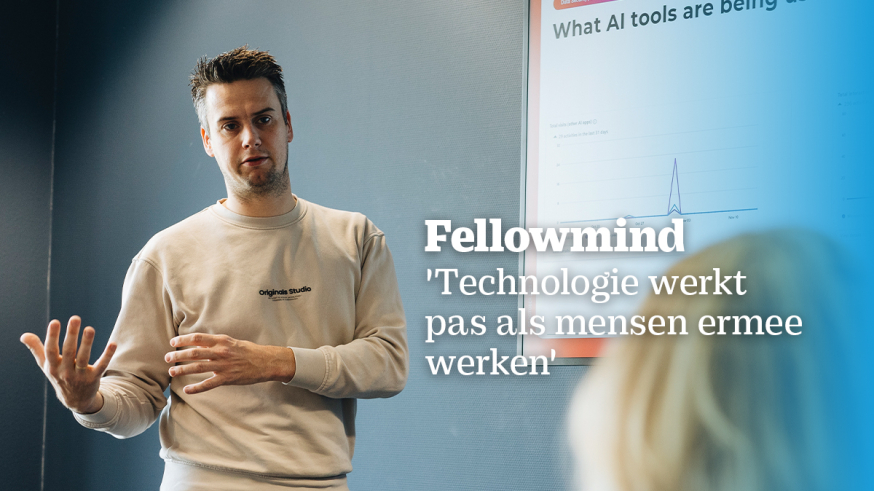
Fellowmind shows how this development plays out in practice. Johan Voerman and Richard Verbeek work daily at the intersection of security and the digital workplace. In their view, these two can no longer be seen separately.
In an environment where employees work everywhere and systems are continuously accessible, security becomes part of how people work. This means that technology, policy, and adoption must go hand in hand.
As Johan points out: technology alone is not enough. Without people, there is no organization, and without an understanding of processes, security remains theoretical.
People, Process, and Technology in Balance
This human factor recurs in several contributions. Cybersecurity is not purely a technical issue, but a combination of behavior, governance, and tooling.
TSTC emphasizes that security only truly lands when teams understand what they are doing and why. Training, certifications, and governance structures ensure that security does not become fragmented but becomes part of the organization.
At the same time, attention is shifting to data resilience. Anthony Cusimano from Object First points to the growing threat of ransomware and the fact that backups are increasingly becoming targets.
Immutable storage and zero-access principles ensure that data remains protected, even if systems are compromised. Thus, recovery becomes just as important as prevention.
Cybersecurity is evolving from a cost center to a strategic foundation. Organizations that have their security in order can grow faster because they manage risks instead of avoiding them.
Structure as a Condition for Growth
Where cybersecurity revolves around protection, software and cloud revolve around structure. Here, the foundation for oversight, collaboration, and scalability is created.
Many organizations grow from disparate tools and pragmatic choices. This works at first, but over time leads to fragmentation. Information becomes scattered, processes become dependent on individuals, and insight disappears.
Control only arises when systems, data, and processes come together in one coherent whole.
From Disparate Tools to Architecture
The software stack of an organization largely determines how scalable that organization is. As described in the main text, a layered structure works best: core systems, integrations, and on top of that AI.
Cloud plays a central role in this. Not because 'the cloud' automatically solves problems, but because it offers the possibility to organize information centrally and enforce governance.
The cloud article shows that control does not arise from technology alone, but from design. Data, access rights, processes, and costs must be actively managed.
This also calls for a different role for IT. No longer just management, but oversight of architecture, integrations, and policy.
Maintaining Control in an As-a-Service World
The rise of as-a-service makes IT more flexible, but also more complex. Organizations work with multiple suppliers and platforms, increasing dependencies.
The challenge thus shifts from adoption to control. Architectural choices, cost management, and security must be actively directed.
Additionally, AI is playing an increasingly larger role within software and cloud. Not as a separate innovation, but as an integrated layer within systems.
From meeting assistants to IT monitoring and logistical optimization: AI helps to accelerate processes and increase insight. Precisely because it operates in the background, the impact becomes greater.
The most important condition, however, remains the same: control. Without grip on data, processes, and systems, technology remains a risk instead of an opportunity.
Further Reading in Baaz Magazine
This article forms the foundation of the WinmagPro section of this edition of Baaz Magazine. In the following articles, the technical themes will be further explored with concrete solutions and practical examples.
This is not all; we also dedicate many pages to the broader strategic and entrepreneurial side of growth. For this, we refer to the Baaz section of this edition, where much more can be found. Baaz Magazine is already available online and will soon be available in print. Do you never want to miss an edition? Then take out a subscription!