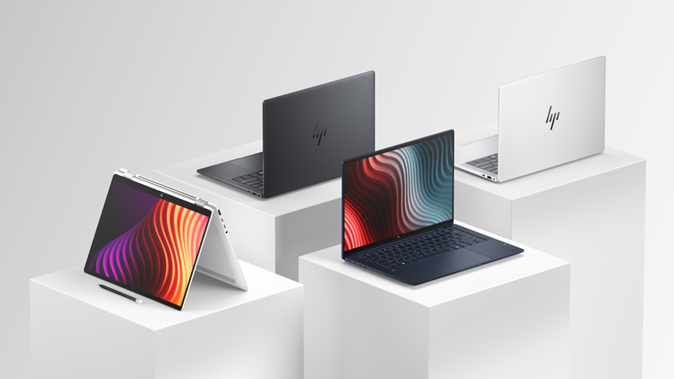

The EliteBook X G2 is the key laptop pillar in this announcement: a Copilot+ AI business laptop line where local AI performance, mobility, and enterprise security come together. The EliteBoard G1a is the striking new form factor for hybrid teams, shared workspaces, and meeting rooms.
Both product lines are positioned by HP as a response to a work reality where expectations continue to rise, while time and attention do not grow accordingly. In this context, devices must not only be faster but also smarter in managing performance and energy, and at the same time more resilient against new threats, including scenarios where employees work offline or on the go.
Why HP is now linking "intelligent work" to local AI
The term "AI at the workplace" has long been synonymous with cloud services: copilots, summaries, translations, and analyses that run through data centers. HP is now explicitly shifting the focus towards local AI processing: tasks that can (partially) run on the device itself via an NPU (neural processing unit). This is not just a marketing story; it aligns with several practical IT considerations that have been increasingly recurring lately.
First, there is the friction of dependency. Cloud AI is powerful, but you are always bound by latency, connectivity, and sometimes also by data flows that you would prefer to limit. Secondly, compliance and data minimization come into play: organizations that process sensitive information want to be able to control where data goes, what stays local, and when external processing is actually needed. Thirdly, there is the need for consistency in user experience. If AI functionality becomes part of daily workflows, you do not want "the smart features" to suddenly become less usable when someone is on a train, working in a poorly connected environment, or temporarily has no VPN connection.
In this context, HP refers to figures from its own Work Relationship Index and states, among other things, that 62% of office workers report that expectations have risen over the past year, while 20% say they experience a healthy relationship with work. Additionally, HP points to a gap between expectations and resources and states that 44% of employees feel that their technology fits their way of working. These are not technical metrics, but they do explain why vendors are now focusing on devices that bring AI closer to the user, with fewer barriers in performance, energy, and security.
TOPS and NPU: why those figures appear in every AI PC release
When suppliers talk about local AI performance, the term TOPS (Tera Operations Per Second) comes up almost immediately. It is an indication of how many AI-like operations a chip can process per second. In AI PCs, this often concerns the NPU: a component that can run AI tasks more efficiently than a CPU or GPU, aiming for better performance-per-watt.
At the same time, TOPS is not a complete predictor of "how fast does this feel in my workflow?" The practical outcome also depends on software support (drivers, frameworks), memory/IO, and whether applications actually utilize the NPU. In an enterprise context, it is therefore more meaningful to read TOPS as a selection signal (what class of device is this?) rather than as a guaranteed user experience.
HP EliteBook X G2 Series: one platform, multiple chip routes
With the HP EliteBook X G2 Series, HP draws a line that IT departments have seen become increasingly complicated in recent years: choice between different chipset ecosystems, often linked to totally different device families. HP now states that "for the first time" within the same HP EliteBook X G2 platform, it offers a choice of AMD, Intel, and Qualcomm processor options. This is interesting because it – in theory – allows for standardizing one device family for procurement, support, and management, while still being able to manage the underlying platform per role.
HP positions the G2 Series explicitly as a premium business line for leaders and professionals who need to run "AI-driven workflows" without compromising on mobility. The portfolio is also broadened with design and configuration options: the EliteBook X G2 Series comes in Glacier Silver, Atmospheric Blue, and Eclipse Gray; according to HP, features and colors are available for all configurations. Sustainability is also explicitly included: the line is according to HP EPEAT 2.0 Gold Registered Product (and fits into a broader sustainable IT approach).
What you can primarily take away from this as an IT professional is that HP does not position the EliteBook X G2 Series as one "hero device", but as a platform choice: the same family, different performance profiles, and therefore (possibly) less variation in management processes than if you need a different product line for each chipset.
AI performance per model: NPU and platform TOPS as selection criteria
HP splits the EliteBook X G2 Series into variants that each receive their own AI profile. This is done in two ways: via NPU TOPS (specifically for local AI) and via platform TOPS (a broader sum/positioning at the platform level).
1) HP EliteBook X G2q: focus on maximum NPU capacity
The HP EliteBook X G2q Next Gen AI PC is positioned by HP as a leader in local AI: up to 85 TOPS NPU performance, powered by the latest generation Snapdragon X2 Elite processor. HP states that the model is intended for processing and simultaneously running AI applications on the device itself. HP presents the EliteBook X G2q as one of the fastest options for mobile local AI and even calls the model 'the world's first business notebook with up to 85 TOPS NPU. In practice, this type of positioning is particularly relevant if you expect AI tasks to structurally land on the NPU (think of on-device assistants, real-time transcribing/summarizing, or AI features in creative/communication tools) and you want to be as independent as possible from cloud acceleration.
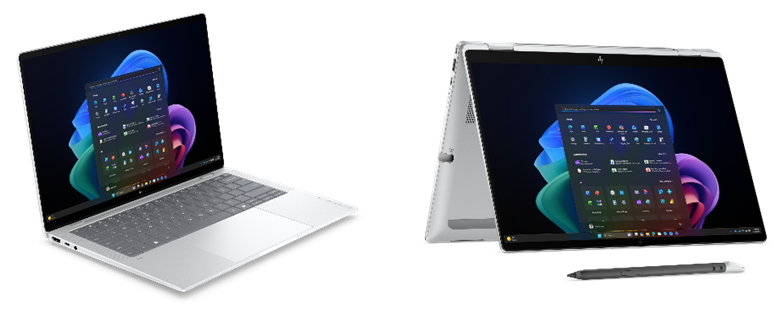
HP EliteBook X G2q Next Gen AI PC (left) & HP EliteBook X Flip G2i Next Gen AI PC (right)
2) HP EliteBook G2i: platform-wide performance for heavy (including graphical) AI tasks
The HP EliteBook G2i Next Gen AI PC will be equipped with the new Intel Core Ultra Series 3 and is specifically positioned by HP for "graphically demanding AI apps". HP mentions up to 50 NPU TOPS and up to 180 platform TOPS. This sounds like a profile for users who want not only AI features but also broader platform performance, such as heavier visualization, multi-app workflows, or content-intensive collaboration.
3) EliteBook X G2a: AMD Ryzen AI with an emphasis on faster AI performance
The HP EliteBook X G2a comes with the latest AMD Ryzen AI processor and up to 55 TOPS NPU, according to HP. In portfolio terms, this can take a middle position: clearly stronger in local AI capacity than generic NPUs from earlier generations, but differently positioned than the Qualcomm variant with up to 85 TOPS NPU. In terms of TOPS values, this version roughly falls between the "maximum NPU headroom" route (G2q) and the Intel route that HP links to heavier (including graphical) AI workloads (G2i, up to 50 NPU TOPS / 180 platform TOPS) – where the best choice ultimately depends on workload and platform preference.
Importantly, HP is essentially bringing a recognizable enterprise question back to the table, but now in AI terms: what role does each performance profile get? In practice, that choice revolves around three things: how many AI tasks you really want to run locally (NPU load), how heavy the rest of the workload is (for example, graphical/multitasking), and which chipset strategy best fits your standardization and management frameworks. The value of this portfolio lies not only in "highest TOPS", but in the fact that HP explicitly makes the choice within one business family.
Quick clarification per profile:
- Much on-device AI / maximum NPU headroom → look at the G2q position (85 TOPS NPU).
- Broad platform performance + heavier graphical workloads → G2i position (50 NPU TOPS / 180 platform TOPS).
- Strong AI upgrade with AMD profile → G2a position (55 TOPS NPU).
User experience & mobility: Smart Sense, Flip form factor, and ultra-light design
Within the EliteBook X G2 family, HP positions "AI PC" not only as a performance class but as a mobile work experience that remains predictable under AI + video + multitasking. In addition to silicon and TOPS, HP emphasizes that "intelligent work" is not just about more computing power, but also about consistent behavior under varying conditions: video meetings, multiple apps at once, AI features in the background, and at the same time a device that does not overheat or drain the battery at the wrong moment.
That is why HP places great emphasis on HP Smart Sense. According to HP, this is a built-in AI-driven layer that adjusts power, thermal properties, and system settings in real-time to the situation. In enterprise terms, you can read that as an attempt to avoid having to tweak performance "manually" (or per policy), but to dynamically optimize it on the device itself. In hybrid environments – where users move from office to home, train, and client location – this can make the difference between a laptop that is theoretically fast and a laptop that remains predictable in practice.
HP also mentions several forms and usage scenarios:
- The EliteBook X Flip G2i supports laptop, tent, tablet, and stand modes and can be delivered with an optional stowable pen. This is a relatively concrete choice for professionals who regularly present, annotate, or collaborate in workshops.
- The EliteBook X G2i would weigh less than 1 kg and offer a battery life of "a whole day". HP also mentions a 3K Tandem OLED screen option. The latter is interesting for those who do a lot of visual work or simply want better readability during long screen use, but it is also typically a trade-off in battery consumption, price, and availability per configuration.
The common thread: HP is trying to sell "AI PC" not just as a performance class, but as a mobile work experience that does not collapse when you combine heavy tasks (AI + video + multitasking).
Security as a common thread: HP Wolf Security and quantum-resistant protection
AI functionality not only shifts workloads but also risks. More local processing often means that more data (temporarily) ends up on endpoints, and that the endpoint becomes a more important part of the total security chain. HP therefore positions HP Wolf Security for Business as a foundation, emphasizing hardware-enforced protection that works "below, in, and above" the operating system. The company explicitly links this to "quantum-resistant" security and to scenarios where users work offline or on the go.
The latter is relevant: security is often most vulnerable in places where management and control are less obvious (home networks, travel, ad-hoc workspaces). HP's message is that the security layer must not be entirely dependent on constant connectivity or only software-based controls.
Quantum-resistant: what should IT do with that?
"Quantum-resistant" is a term that vendors use to show that they are taking into account the transition to post-quantum cryptography and related threat models. For IT, it is mainly a signal to ask further questions: where is it exactly (firmware, identity, storage, attestation) and how is that maintained over the lifecycle? In a business fleet, not only the claim counts, but especially the assurance in updates, management, and compatibility.
EliteBoard G1a: a desktop that you can move
While the EliteBooks fill the mobile side of the story, the HP EliteBoard G1a Next Gen AI PC does something different: the product shakes up the desk itself. HP also calls the EliteBoard the smallest and lightest AI PC in its portfolio, intended to bring local AI performance to the place where work is currently happening. HP describes it as a "unique, keyboard-based form factor" and even as "the world's first fully integrated AI PC in a keyboard". The goal is clear: instead of a fixed desktop or a laptop that you always carry, HP wants to establish a category that you pick up at a workspace just like you currently pick up a keyboard – but with computing power on board.
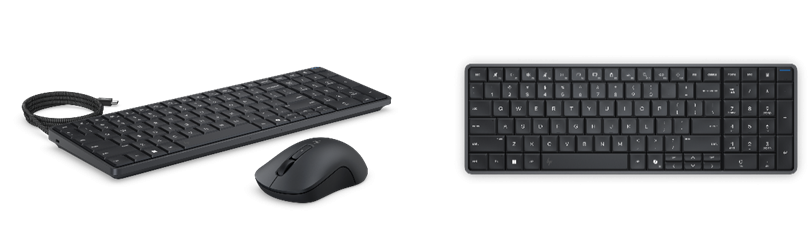
HP EliteBoard G1a Next Gen AI PC
Specifically, HP mentions a ultra-thin profile of 12 mm and a weight of 750 grams. At 750 grams, the keyboard would also weigh less than half of a traditional notebook PC, according to HP. This is light enough to position the EliteBoard as "takeaway compute", but it also indicates that HP is primarily targeting environments where screens are already present: flex offices, shared desks, project rooms, or temporary setups. HP integrates dual microphones and speakers into the keyboard and emphasizes that the device easily connects to displays of "any size".
Under the hood, the EliteBoard runs on an AMD Ryzen AI 300 series processor with more than 50 TOPS NPU, according to HP. Here too, Smart Sense plays a role, along with AMD Auto State Management (ASM) and an optional built-in battery, intended to dynamically optimize performance, cooling, and energy consumption. Interestingly, HP does not only position the device as "handy", but as a means to truly personalize workspaces: you take your compute with you, but determine how your screen setup and work style look at each location.
Security is also explicitly addressed here: HP links Wolf Security to protection against firmware attacks and quantum threats, and also mentions a secured, lockable cable to physically secure the device. The latter may sound trivial, but it fits perfectly with this concept: once compute becomes portable, theft prevention and physical control suddenly become more important.
EliteBoard G1a in brief
- Form factor: PC in keyboard (12 mm, 750 g), intended to move between workspaces.
- Audio: dual microphones and speakers integrated.
- AI: >50 TOPS NPU (AMD Ryzen AI 300 series).
- Optimization: Smart Sense + ASM + optional battery.
- Security: Wolf Security + physical cable locking.
HP Series 7 Pro 4K Monitor: the monitor as a visual (and connectivity) hub
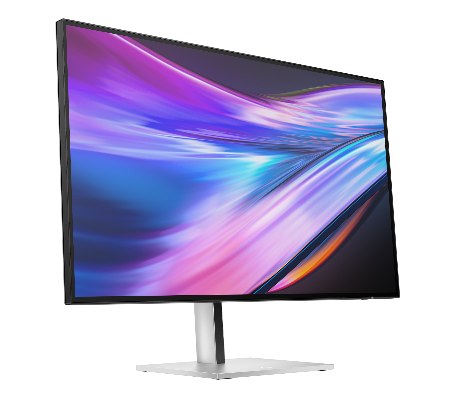
HP Series 7 Pro 4K 732xk Monitor
HP connects the EliteBoard not only to compute but also to the "canvas" on which work is done: the monitor. With the HP Series 7 Pro 4K Monitor (model 732xk), HP targets professionals who need color accuracy and consistent performance, and on workflows where one desk is no longer enough (multi-device, multi-screen).
The monitor combines IPS Black with "next-gen Neo:LED" display technology in 4K; HP positions it as the "first Neo:LED desktop monitor" in the world.
Additionally, HP emphasizes professional, factory-calibrated color accuracy and custom user color profiles. For creative or visually critical environments, this is a concrete point: you want to be able to trust what you see, especially when switching between devices or workspaces.
For IT and workplace management, connectivity is particularly relevant: HP mentions Thunderbolt 4 with 140W and 40 Gbps, intended for data and video processing via a single cable. In a modern office landscape, this is often at the core of "frictionless working": fewer loose adapters, fewer docking variants, faster switching between devices. In combination with an EliteBook (or an EliteBoard setup), this works as a hub approach: one cable for image, data, and (where applicable) power.
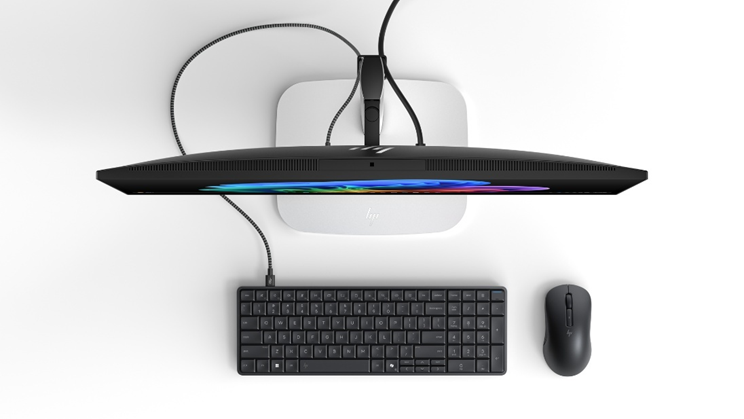
HP redefines the work desk of the future
Manageability & sustainability: EPEAT 2.0 Gold and serviceability as an IT argument
HP does not only make sustainability a "badge", but links it to manageability. Both the HP EliteBook X G2 Series and the EliteBoard G1a are mentioned as EPEAT 2.0 Gold. In an enterprise context, this is often part of procurement criteria, but it only gains real value when it comes together with lifecycle and repair strategies.
Therefore, one of the most tangible points in the announcement of the HP EliteBook X G2 Series is not AI-related: HP states that it uses a new design with top-mounted components that reduces keyboard replacement time by up to 80%. In large device fleets, this is the kind of detail that can have a direct effect on turnaround time, downtime, and TCO. Faster replacement means faster return to production and makes refurbish/redeploy easier to schedule.
Why serviceability is again a main theme in 2026
AI capacity leads to longer wish lists, but organizations still want to maintain control over costs and lifecycle. Repair-friendliness plays a dual role in this: it reduces support pressure and helps keep devices profitable longer (especially if parts are quicker to replace). In that sense, serviceability fits remarkably well with the "AI era": more value at the endpoint, so also more value in keeping the endpoint healthy longer.
Price and availability
For organizations planning pilots with Copilot+ PCs in 2026, the availability of the HP EliteBook X G2 is a practical factor in refresh and evaluation planning. HP has not yet shared prices; these will follow later. However, there is an indication for availability via HP.com:
In practice, this is relevant for planning: those who want to refresh or conduct pilots with AI PCs in Q1/Q2 2026 can roughly determine the window in which evaluation hardware will become available.
Availability according to HP:
- HP EliteBook G2i Next Gen AI PC: February 2026
- HP EliteBook X Flip G2i Next Gen AI PC: February 2026
- HP EliteBoard G1a Next Gen AI PC: March 2026
- HP Series 7 Pro 4K 732xk Monitor: March 2026
- HP EliteBook X G2a Next Gen AI PC: Spring 2026
- HP EliteBook X G2q Next Gen AI PC: Spring 2026
Conclusion: one AI portfolio, multiple work forms
With the HP EliteBook X G2 Series and the EliteBoard G1a, HP shows that "AI PC" does not have to be one category. The laptops fulfill the classic enterprise need: mobility, performance, security, and manageability in a recognizable form factor, with a choice of multiple chipset platforms within one family. The EliteBoard is particularly interesting because it redefines the endpoint: compute as something you can take to a workspace, without necessarily opening a laptop.
What connects all the announcements is that HP does not see local AI in isolation from prerequisites. NPU/TOPS is one layer, but on top of that come dynamically optimized (Smart Sense), hardware endpoint security (Wolf Security, quantum-ready positioning), and an emphasis on serviceability. For IT, that ultimately is the test: not only "can it do AI?", but also "is it manageable, secure, and predictably deployable in the fleet?"